

The Interstellar Collection
Black Friday Special: Moon, Mars, Asteroid Dust + Iron Campo Meteorite
Black Friday Special: Moon, Mars, Asteroid Dust + Iron Campo Meteorite
Couldn't load pickup availability
Here's the deal! Black Friday is only once a year, and we want to celebrate by offering you this limited time holiday offer of all 3 of our popular dust vial sets (Lunar, Martian and Carbonaceous Asteroid) PLUS an iron meteorite that, upon impact, contributed to the creation of 26 HUGE craters - one being the size of a professional stadium football field!
What you are getting:
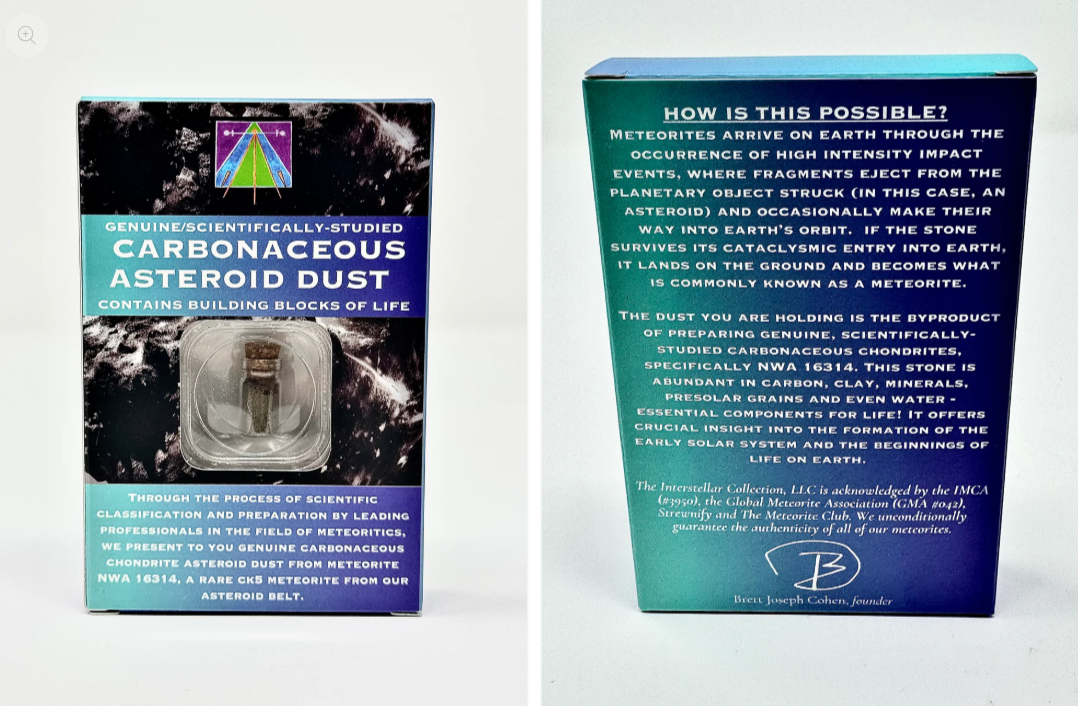
You'll receive 3 beautiful boxes containing 3 different, authentic and scientifically-studied meteorite dust vials inside - one filled with genuine Martian meteorite dust from Mars, another filled with genuine Lunar meteorite dust from the Moon and finally, genuine Carbonaceous Chondrite meteorite dust - dust from a carbon-rich asteroid - just like Asteroid Bennu! These types of Asteroids contain organic molecules and could have even been responsible for the materialization of life on Earth!
All 3 vials are encased separately in membrane display cases designed for a 3 dimensional view of the dust!
The meteorites themselves that this dust derived from has been scientifically studied and confirmed by leading scientists in the field of Meteoritics, and have been identified and officially named as the following:
Lunar: Adrar 013, a rare anorthositic lunar gabbro-norite meteorite from our moon.
Martian: Amgala 001, an olivine-phyric Shergottite from Planet Mars.
Carbonaceous: NWA 16314, from a carbon-rich asteroid, classified as a CK5
**These are big hits for holidays and birthdays. Give the most perfect, unique gift this year!**
What is meteorite dust, and how did we get it?
When we slice scientifically studied meteorites, we sanitize the collection basin and collect the residual dust. We provide it to jewelry makers, guitar builders, artists, collectors and much more! The dust comes in a beautiful display box offering further information, including the official name of the Meteorite which the dust derived from, which can be further researched on the Meteoritical Bulletin!
That's not all you're getting...
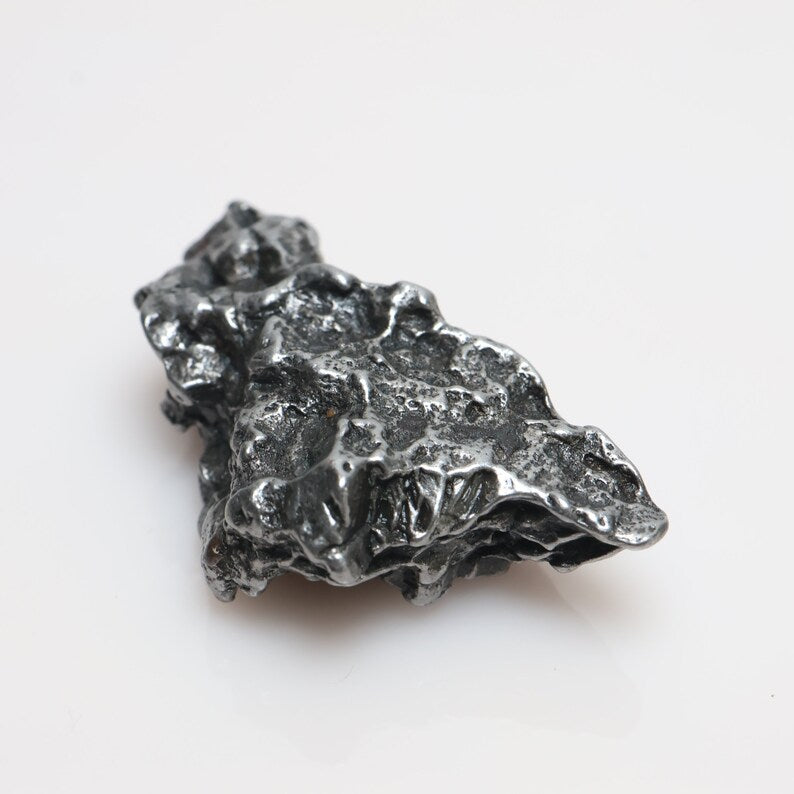
As part of the Black Friday sale, you'll also receive one genuine Campo iron meteorite. We hand pick each one we send out to you, but rest assured, they will all look very similar to what you see in the photos and will fall between 10-20 grams! No two are exactly alike!
Fun Facts about the famous Campo Del Cielo meteorite:
Campo Del Cielo's crater field is so large that it covers an area of 11.5 by 1.9 miles and contains at least 26 craters, the largest being 377 by 299 feet in diameter!
The name Campo del Cielo is Spanish for "Field of Heaven," a fitting description for the region where fragments of the meteorite were originally discovered.
The meteorite impact is estimated to have occurred between 4,000 and 5,000 years ago.
The total estimated mass of the original celestial body was several tons.
Scientists believe the meteorite fractured into many pieces as it entered the Earth's atmosphere, resulting in a large scattering of fragments across the impact area.
Learn more about these incredibly unique products below:
How do we know the dust is really from the Moon?
Our moon lacks an atmosphere. When asteroids encounter these celestial bodies (which happens frequently), fragments eject from the impact and occasionally make their way into Earth’s orbit. If the stone survives its cataclysmic entry into Earth, it lands on the ground and becomes known as a meteorite. Once studied under a microscope by leading scientists in the field of Meteoritics, the stone's origin is then plotted based on its compositional property to the different classes of asteroids and samples returned to Earth. Lunar meteorites specifically are compared to samples returned by NASA's Apollo mission astronauts. From there, meteorites make their way into museums, universities and to the general public all around the world.
How do we know the dust is really from Mars?
Just like our moon, Planet Mars also encounters Meteoroid impacts quite often. With enough velocity, chunks of Mars can eject and escape its own gravity, sending them on a journey through interplanetary space. If the sun or Earth’s atmosphere doesn’t burn them up and they survive their violent descent to Earth, they have the chance of being discovered, studied and classified by leading scientists in the field of Meteoritics! Using microscopic (thin sections), chemical, and isotopic analysis, scientists compare the stone’s composition to known planetary materials.
But the most definitive evidence comes from gas trapped inside the rock!
Martian meteorites contain tiny bubbles of gas sealed within glassy inclusions. When analyzed using mass spectrometry, the gas composition matches the Martian atmosphere exactly as measured directly by NASA’s Viking landers in the 1970s and confirmed by later missions like Curiosity. The match is so specific that there's no other natural source on Earth (or elsewhere) with the same gas profile.
"Did You Know" this about Carbonaceous Asteroids/Meteorites?
Bennu, a near-Earth carbonaceous asteroid, was a recent target of NASA's Osiris Rex mission whose objective was to collect samples and return them to Earth for study!
About Iron Meteorites:
Iron meteorites consist almost entirely of nickel and iron and are thought to originate from the cores of ancient, differentiated asteroids. In the early solar system, these large asteroids underwent internal melting, causing heavier elements like iron and nickel to sink toward their centers—much like the Earth’s own core. Over time, catastrophic collisions shattered these bodies, sending fragments hurtling through space until some eventually landed on Earth as meteorites.
One of the most striking features of iron meteorites is the Widmanstätten pattern—a distinctive interlocking crystalline structure of nickel-iron alloys that can be revealed through careful acid etching. This process requires expert preparation, including stabilization, slicing, and polishing, as even slight errors can damage the specimen. The pattern itself is often called the meteorite’s “thumbprint” because it is entirely unique and cannot be replicated in laboratory conditions. Its formation requires incredibly slow cooling—about one degree Celsius every 10,000 years—making it a visual testament to the vast timescales and processes that shaped our solar system.
The Interstellar Collection, LLC is acknowledged by the IMCA (#3950), the Global Meteorite Association (GMA #042), the Meteorite Club and Strewnify. We unconditionally guarantee the authenticity of all of our meteorites.
Our Guarantee
Our Guarantee
The Interstellar Collection, LLC is acknowledged by the IMCA (#3950), the Global Meteorite Association (GMA #042) and the Meteorite Club. We work directly with scientists in the field of Meteoritics to bring genuine meteorite specimens into the hands of museums, universities and to the general public. We unconditionally guarantee the authenticity of each meteorite we sell.
Shipping, Returns & Insurance
Shipping, Returns & Insurance
Please read and confirm all of the details in the link below for the most up to date information on our Return Policy:
Care Instructions
Care Instructions
How do I care for my meteorites?
Please visit our FAQ page on our website for the most up to date information on Meteorite care.
Share