The Interstellar Collection, LLC
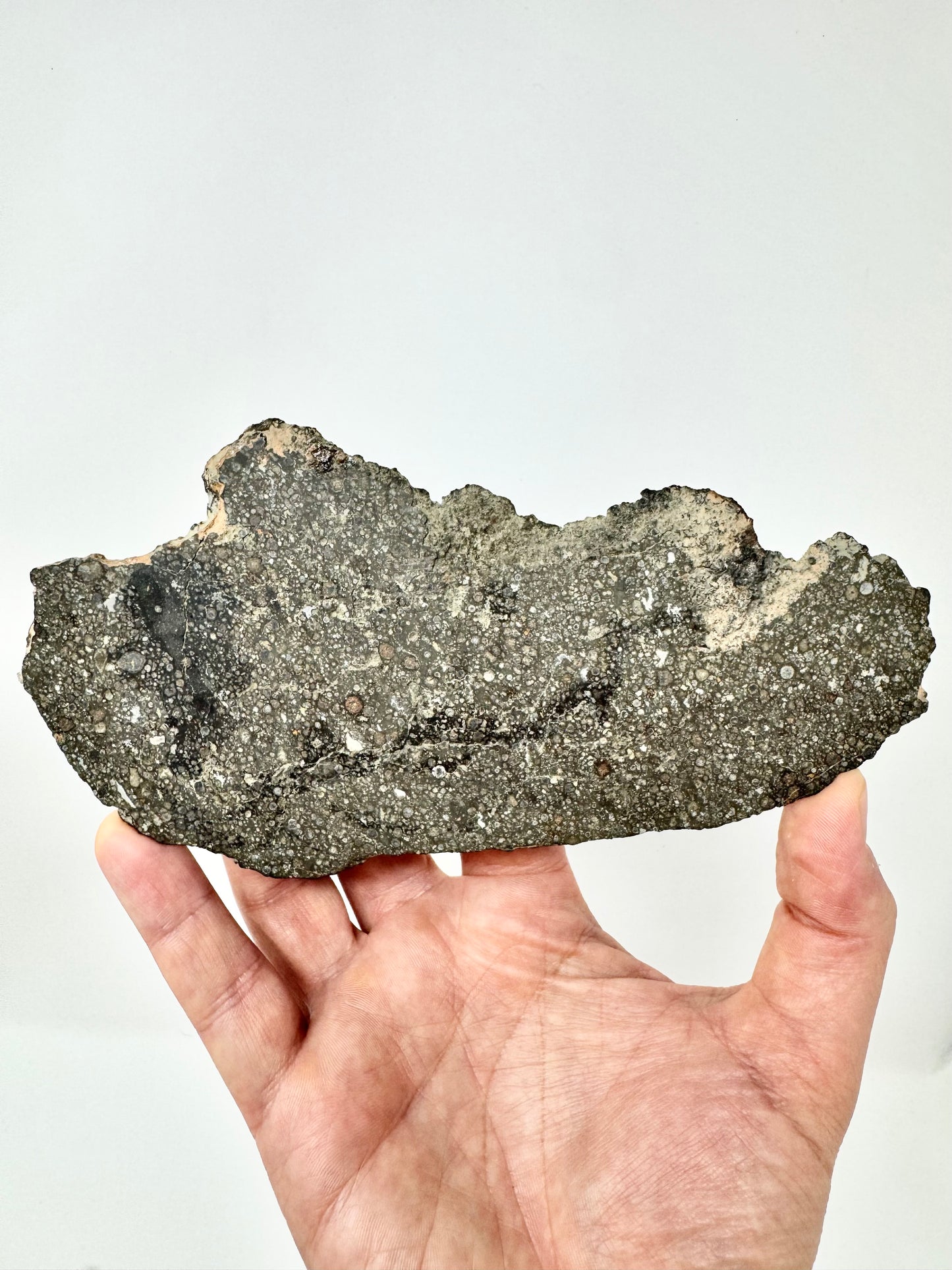
73.1g Stunning FULL SLICE of NWA 3118 CV3 Carbonaceous Chondrite Meteorite
73.1g Stunning FULL SLICE of NWA 3118 CV3 Carbonaceous Chondrite Meteorite
Couldn't load pickup availability
Meteorite NWA 3118 is a rare Carbonaceous Chondrite of the CV3 type. Meteorites like this are scientifically significant because they provide insights into the early Solar System, containing carbon, clay minerals, water, and organic compounds that may help us understand the origins of life on Earth. This specimen is notable for its rugged surface, a pinkish hue on the side not meant for display, and Calcium-Aluminum-rich inclusions (CAIs) that formed around 4.6 billion years ago, at the very beginning of the Solar System.
Carbonaceous chondrites are a significant subset of stony meteorites that provide valuable insights into the early solar system's history. These meteorites make up an extremely small portion of the total number of fallen meteorites and are classified into several distinct, rare groups, based on their chemical composition, mineralogy, and oxygen isotopic signatures.
Like other chondrites, carbonaceous chondrites have undergone varying degrees of alteration, whether through exposure to water, heat, or a combination of both. In the case of this particular meteorite, this is a carbonaceous chondrite of the CV group that is petrologic type 3.
About CAI’s:
Calcium-Aluminum Inclusions, known as CAIs, are some of the earliest solid substances that formed from the solar nebula. They are present in certain carbonaceous chondrites, which are ancient meteorites. CAIs are characterized by their high levels of calcium and aluminum and consist of high-temperature minerals, making them significant for researchers exploring the origins of the solar system.
These inclusions typically contain minerals like melilite, anorthite, and spinel, and frequently exhibit isotopic variations. Such anomalies provide valuable information regarding the early solar system's conditions and the nucleosynthesis processes associated with supernovae and AGB stars. The existence of CAIs in carbonaceous chondrites signifies that these meteorites hold some of the oldest materials from the formation of our solar system, aiding scientists in their studies of solar system development and history.
About Stony Meteorites:
Stony meteorites are the most common meteorites, making up the majority of the meteorites discovered here on Earth. They are divided into two groups: chondrites, which are some of the oldest primitive material in our entire solar system originating from large asteroids, and achondrites, which include meteorites that derived from our moon and Mars.
*Note - Lunar and Martian-originated meteorites will always be indicated as such on the listing. Any other meteorite listed will have originated from an asteroid.
Our Guarantee
Our Guarantee
The Interstellar Collection, LLC is acknowledged by the IMCA (#3950), the Global Meteorite Association (GMA #042) and the Meteorite Club. We work directly with scientists in the field of Meteoritics to bring genuine meteorite specimens into the hands of museums, universities and to the general public. We unconditionally guarantee the authenticity of each meteorite we sell.
Shipping, Returns & Insurance
Shipping, Returns & Insurance
Please read and confirm all of the details in the link below for the most up to date information on our Return Policy:
Care Instructions
Care Instructions
How do I care for my meteorites?
Please visit our FAQ page on our website for the most up to date information on Meteorite care.
Share